010 / DANGEROUS WORK
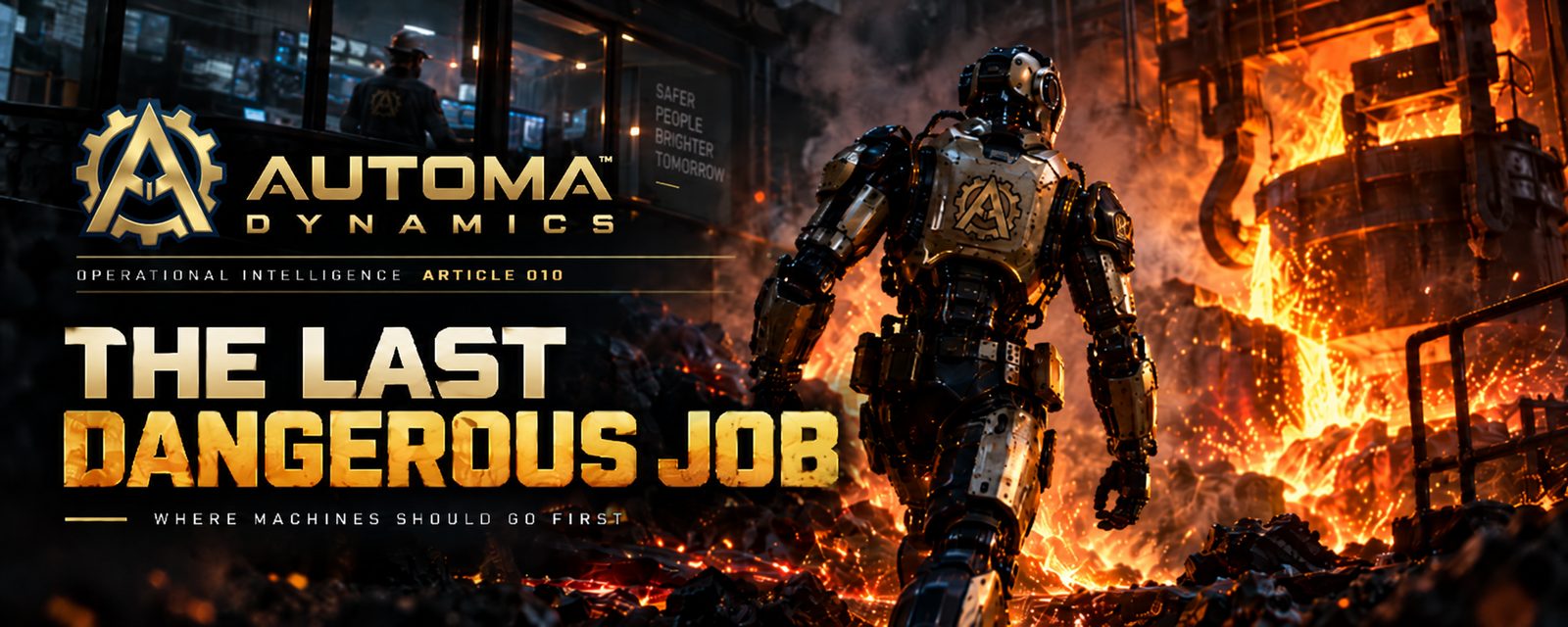
The most compelling case for general purpose robots may not be that they can do our jobs. It may be that they can do the jobs we should never have had to do in the first place.
Every industrial economy still depends on work that exposes people to heat, radiation, toxic chemicals, collapsing structures, heavy machinery, confined spaces, explosive environments and unpredictable physical risk. We have become very good at regulating these jobs. We have become much less good at asking whether humans should still be doing them at all.
The arrival of capable humanoid robots creates a different question.
Not: Which jobs can robots replace?
But: Which dangerous job should be the last one we ever ask a person to do?
Automation Usually Begins With Economics
Industrial automation has traditionally followed a fairly simple logic. Find a task that is repetitive, stable and high volume. Automate it. The return on investment is easy to calculate. The machine runs faster, more consistently, or more cheaply than the equivalent human process.
This is why the most automated environments often contain the most predictable work:
- assembly,
- packaging,
- material handling,
- inspection,
- repetitive welding,
- precision placement.
Dangerous work presents a different economics. The task may occur infrequently. The environment may change constantly. The conditions may be too chaotic for conventional automation. A refinery inspection after an incident does not look like a production line. Neither does entering a damaged building, cleaning contaminated equipment, or maintaining machinery beside extreme heat.
These environments have historically resisted automation precisely because they are difficult. That is where general-purpose robotics becomes interesting.
The Most Valuable Robot May Be the One We Hope Never to Use
Some machinery earns its value by operating constantly. A dangerous environment robot may earn its value by being available when something goes wrong. That makes it economically strange. A robot that spends most of its time idle could still be extraordinarily valuable if its existence means a worker does not enter a toxic vessel, damaged reactor building or unstable structure.
This is closer to insurance than conventional automation. The value comes from risk avoided, not units produced. That changes the business case. If a machine replaces a worker on a normal task, we compare labour cost with machine cost. If a machine removes a person from a catastrophic risk environment, the calculation includes something much larger:
- injury,
- fatality,
- shutdown,
- investigation,
- regulatory consequences,
- specialist response teams,
- operational delay,
- and reputational damage.
The economics of dangerous work automation may therefore look unattractive right up until the first serious incident. Then they look completely different.
Human Capability Is Still the Benchmark
The reason humans remain inside dangerous environments is not because we are physically suited to them. Often we are exceptionally poorly suited. We need protective equipment, cooling, breathing apparatus, radiation limits, rest periods, exposure monitoring, and emergency extraction.
What keeps humans in these roles is our adaptability. A worker can walk through an unfamiliar industrial site, recognise damaged equipment, manipulate standard tools, interpret labels, move debris, climb stairs and respond when the situation differs from the plan. Specialised robots historically struggle with that combination.
This is why the humanoid form matters. Article 009 made the argument that our built environment effectively exposes a human shaped interface: doors, tools, ladders, workstations and controls were designed around us. Dangerous environments contain the same interfaces.
The difference is that we would strongly prefer nobody had to use them. A robot able to operate the world we built for humans can inherit not only our workplaces. It can inherit our hazards.
Start Where Human Vulnerability Is Highest
Much of the public conversation around humanoids focuses on warehouses and manufacturing. That makes sense. Those environments provide structured tasks, measurable productivity and controlled deployment.
But the highest-value long-term applications may sit further out:
- Fire.
- Radiation.
- Chemical exposure.
- Structural collapse.
- Deep mining.
- Subsea maintenance.
- Explosive atmospheres.
- Extreme temperatures.
- Disaster response.
The Automa Dynamics "North Star" treats extreme environments as a core research territory precisely because autonomy becomes more valuable where humans are vulnerable or physically unable to remain for long periods.
The important word there is valuable. Not impressive. Not futuristic. Valuable. A robot operating in an office is convenient. A robot entering a burning industrial facility instead of a person can change what risk means.
Dangerous Work Is Often Irregular Work
There is a technical reason this is difficult. Hazards rarely arrive in standardised packages. A machine fire does not occur in exactly the same location twice. A collapsed structure creates an environment nobody designed. A chemical leak may block the normal access route. A damaged valve may require an unusual tool. Debris may have moved. Lighting may have failed. Sensors may be unreliable.
The system is operating outside its nominal state. Traditional automation is strongest when the environment behaves exactly as expected. Dangerous work often begins precisely when it does not. That means the robot must combine physical capability with perception, reasoning and robust fallback behaviour. It needs to recognise when its own understanding is weak. It needs to move cautiously when uncertainty increases. It needs to know when to stop. That last capability may matter more than almost anything else.
A Safe Robot Must Know When It Is Out of Its Depth
General purpose robotics creates an uncomfortable tension. The more capable the robot becomes, the more situations we are tempted to send it into. But capability is not the same thing as reliability. A machine may correctly perform a task 99 times and fail on the hundredth because the environment contains something unexpected.
In a warehouse, that may cause a delay. Inside a hazardous facility, the same failure could escalate an incident. So dangerous-work automation cannot rely on confidence theatre. The robot must preserve uncertainty.
It needs to distinguish:
- I know what this object is.
- I think I know.
- I cannot determine it safely.
Those states should produce different behaviour:
- proceed,
- slow down,
- ask for assistance,
- switch to teleoperation,
- or withdraw.
A machine protecting humans from dangerous work should never become dangerous because it is too confident to admit confusion.
Teleoperation Changes the Threshold
This is why full autonomy does not have to arrive first. Imagine a robot entering a contaminated industrial space. It navigates autonomously, inspects equipment, reads instruments, carries tools, and performs routine manipulation. Then it encounters an unusual obstruction.
Rather than improvising indefinitely, the system requests help. A remote specialist takes control. The worker now contributes judgement without entering the hazardous environment. Once the difficult moment is resolved, the robot returns to autonomous operation.
This hybrid model changes the adoption curve. We do not need to solve every possible edge case before the system becomes useful. We need enough autonomy to handle the ordinary physical workload, and enough telepresence to keep humans out of the dangerous zone when novelty appears. That is a much more achievable path.
The Worker Moves Up the Causal Chain
There is a lazy way to frame physical automation: robot arrives, human disappears. Reality is likely to be more complicated. A dangerous-work robot may remove the body from the hazard while keeping the person deeply involved.
The technician becomes a remote operator. The inspector supervises several machines. The specialist intervenes in rare situations. The safety engineer defines operating boundaries. The maintenance worker increasingly maintains the robotic systems that enter environments people once entered themselves. Work moves. The human contribution shifts away from exposure and toward judgement. This may be one of the healthiest forms of automation. We preserve expertise while reducing physical vulnerability.
The Robot Needs More Than a Map
A robot operating inside a dangerous facility cannot simply know where things are. It needs to know what they mean. That pipe carries something hazardous. That valve isolates this system. That room currently exceeds a safe temperature threshold. That container belongs to a controlled process. That piece of equipment cannot be restarted while someone is working downstream.
This is where physical autonomy reconnects with operational intelligence. The robot perceives geometry. The operational system provides context. Together they answer a much more important question: What does this physical action do to the wider system? Turning a valve is mechanically simple. Knowing whether it should be turned can require understanding an entire dependency chain.
That distinction is central to Automa Dynamics's Project HELIOS too:
The programme treats operational truth, ontology, evidence and explicit authority as separate layers beneath AI action rather than allowing model confidence to substitute for governed state.
The same principle becomes even more important when software has arms.
Physical Capability Makes Authority Concrete
Consider a robot that can operate industrial machinery. It sees a stopped pump. It knows how to restart it. Should it? Perhaps not. The pump may be intentionally isolated for maintenance. Someone may be working downstream. A safety interlock may have triggered. Restarting it may violate procedure.
The robot possessing the physical capability to act does not create permission. This is the physical version of the AI-agent problem. A tool is not authority. A hand is not authority. Knowledge is not authority.
The robot needs a governed answer to:
- What am I allowed to do?
- Under what conditions?
- On whose behalf?
- What requires approval?
- What changes during an emergency?
Autonomy without authority design is merely capability with fewer brakes.
Dangerous Environments Need Evidence
After a hazardous intervention, the organisation needs to know exactly what happened. Which robot entered? What did it observe? What actions did it take? Which actions were autonomous? Which involved a remote operator? What evidence justified them? What state changed afterwards?
If something went wrong, the system needs to reconstruct the event. This matters for engineering. It matters for accountability. It matters for improving future behaviour. The same architecture that makes enterprise AI trustworthy - evidence, provenance, state and auditability - becomes part of robotic safety. A robot should not merely report: Mission completed. It should be possible to understand the chain beneath that statement.
Designing for Robots Changes the Workplace
The first dangerous work robots will probably enter environments designed for people. Eventually that may stop making sense. Once machines routinely perform hazardous maintenance, industrial spaces can be redesigned around them. Access points can become machine friendly. Components can be modular. Connections can be standardised. Diagnostic interfaces can become machine readable. Heavy assemblies can include robotic handling features. Inspection points can be positioned for autonomous systems.
This creates a virtuous cycle. First, robots adapt to human infrastructure. Then infrastructure gradually adapts to robots. Dangerous environments may become some of the first places where this transition happens aggressively because the incentive is so strong. If no person should enter the room, there is little reason to keep designing the room around people.
Some Workplaces May Eventually Have No Human Zone
We already have controlled spaces where human access is restricted. Robotic autonomy could push this much further. Imagine an industrial zone designed explicitly around the assumption that no person enters during normal operation. Machines operate continuously. Robots inspect. Other robots maintain them. Humans supervise remotely. When a system fails, the first responder is another machine.
Human physical entry becomes the emergency fallback rather than the default maintenance model. That inversion would be profound. Today we often automate the task and leave humans responsible for the exceptions. Tomorrow we may automate the environment itself and treat human entry as a failure of the autonomous system.
The Hard Part Is Not Sending the Robot In
Eventually, physically entering a dangerous area may become the easy part. The hard questions are organisational.
- Does the robot understand the situation?
- Does it understand the dependencies?
- Does it know which actions are safe?
- Does it know what it cannot determine?
- Can a human intervene remotely?
- Can the system prove what happened?
- Can the robot recover from failure without making things worse?
- Can the organisation trust it enough to keep a person outside?
That final question is the real threshold. A dangerous-work robot succeeds not when it demonstrates impressive capability. It succeeds when the responsible engineer looks at a hazardous task and says:
No. We are not sending a person in there anymore.
The Last Dangerous Job May Not Disappear All at Once
There probably will not be a single moment when dangerous work ends. Different environments will automate at different rates. Structured industrial facilities may move first. Emergency response will remain harder. Some jobs may be partly autonomous for decades. Humans may still enter when machines fail or encounter situations beyond their capability.
The boundary will retreat gradually. But retreat matters. Every task moved behind a blast wall, a radiation boundary, a remote console or a robotic body represents real progress. The objective does not need to be instant replacement. It can be a continual reduction in the circumstances under which human flesh is considered an acceptable component of an industrial process. That is an engineering goal worth taking seriously.
The Best Deployment Is the One Nobody Mourns
There will be difficult social questions around automation: employment, status, distribution of economic gains, ownership, and transition. Those debates deserve serious treatment. But dangerous work offers one area where the direction should be easier to defend.
There are jobs whose disappearance should feel like progress. Jobs where the relevant skill can remain while the exposure does not. Jobs where sending a robot is not about making a person cheaper. It is about making the person safer. That may become one of the clearest moral arguments for physical autonomy.
Not every human task needs to survive simply because humans historically performed it. Some work exists because until now there was nobody else to send. Soon, there may be. And when that happens, the real benchmark for robotics will not be whether a machine can imitate a worker. It will be whether we finally decide that some forms of work are beneath human risk.
The last dangerous job should not end because humans became tougher. It should end because machines became capable enough that sending a person stopped making sense.