007 / OPERATIONAL SEMANTICS
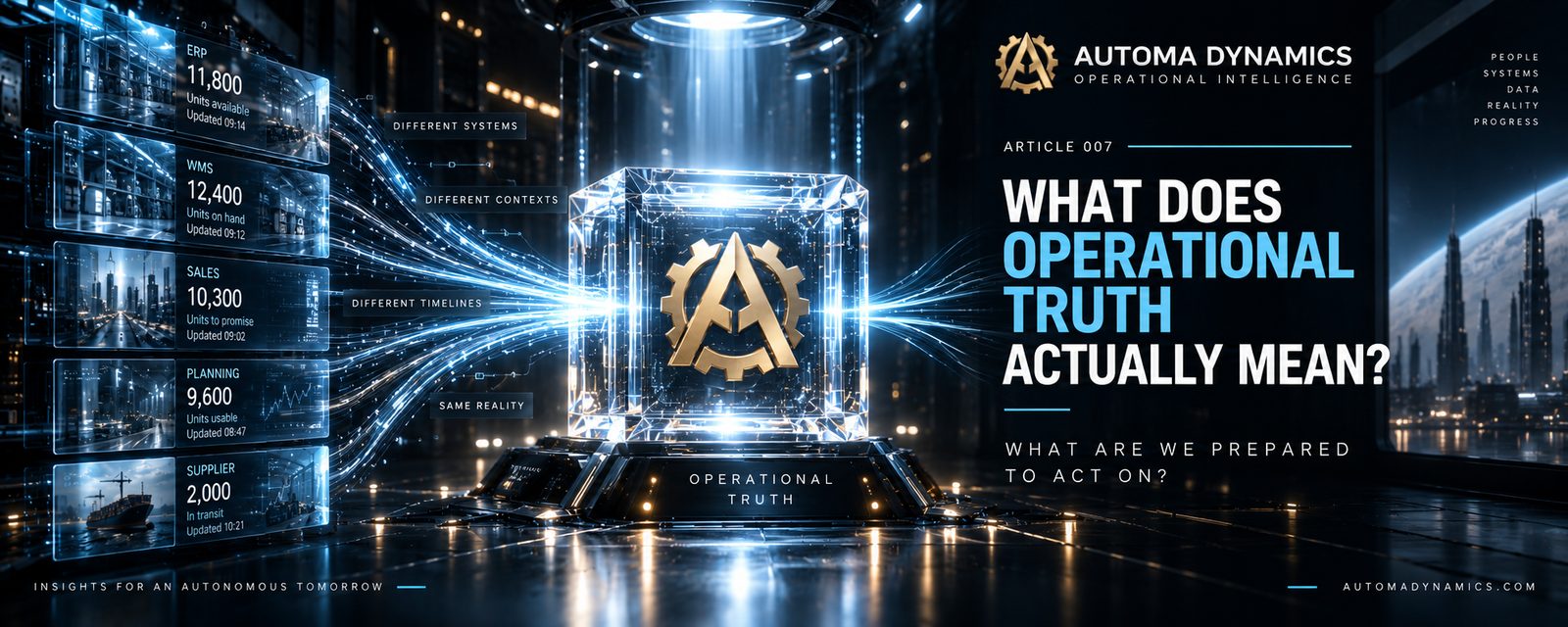
Ask five systems inside a large company the same question and you may receive five different answers. How much inventory is available? The warehouse management system reports 12,400 units physically present. The ERP reports 11,800 booked. Planning considers only 9,600 usable because some stock has already been allocated. Sales believes 10,300 remains available to promise. Someone on the warehouse floor knows that 600 units were damaged an hour ago and have not yet reached any of those systems. Every number may be real. Only one question was asked.
This is where phrases like single source of truth begin to sound much simpler than the problem they describe. Companies do not merely need somewhere to store facts. They need a disciplined way to establish what those facts mean, when they were true, which source had authority to assert them, what superseded them, and what decisions may safely depend on them. That is what we mean by operational truth. And as AI moves closer to the systems that run organisations, getting this definition right becomes critical.
A Record Is Not Yet a Truth
Enterprise systems are full of records. Orders. Shipments. Contracts. Invoices. Inventory positions. Production schedules. Customer notes. Maintenance events. Approvals. A record tells us that some system stored something. Operational truth asks a harder question: What does that record allow the organisation to believe?
Suppose a database contains:
Inventory: 4,000 units
The value appears precise. Operationally, it is almost useless without context.
- Which component?
- At which location?
- Physical quantity or available quantity?
- Measured when?
- Reserved for anything?
- In transit or actually received?
- Quality-approved?
- Counted directly or derived from another value?
- Still current?
A number becomes operationally meaningful only when the surrounding semantics are understood. This is why more enterprise data does not automatically create more organisational knowledge. The organisation can drown in accurate records while remaining uncertain about its actual state.
Truth Begins With Identity
Before software can determine what is true about something, it has to know what that something is. This sounds mundane until real enterprise data is involved. A supplier may appear under its legal name in procurement, a trading name in logistics and an abbreviation in finance. One factory may have several identifiers inherited from previous systems. A component may have an engineering code, supplier code and warehouse code.
Humans routinely resolve these ambiguities through context. Machines need something firmer. If two systems describe MC40, MC-40 and MTR-CTRL-40, are they talking about the same component? If they are, their records can potentially contribute to one operational state. If they are not, combining them produces fiction.
Stable identity therefore sits underneath operational truth. Before asking: "What is true about this object?" the system needs confidence that everyone is referring to the same object. This becomes even more important with AI because language models are exceptionally capable of smoothing over ambiguity. They can infer that two records probably describe the same thing. Operational systems sometimes need probably to remain a question rather than becoming an invisible merge.
Meaning Comes Before Value
Even when identity is clear, two values can describe different properties of the same object. Consider inventory again. Physical stock is not the same as available stock. Available stock is not the same as unallocated stock. Unallocated stock is not necessarily usable stock. Usable stock may depend on inspection status, location, certification, customer reservation or production constraints.
The statement:
"We have 10,000 units."
could therefore be simultaneously correct and dangerously misleading. This is a semantic problem. Operational truth requires the system to know what a value represents, rather than treating every similar looking number as interchangeable.
That principle extends far beyond inventory. A delivery estimate differs from a contractual commitment. An approved supplier differs from a supplier somebody has used before. A forecast differs from an order. A recommendation differs from an authorised decision. A scheduled production run differs from completed production. The vocabulary of the organisation contains distinctions because the distinctions matter. AI can make those distinctions easier to navigate. It should not flatten them.
Time Is Part of the Fact
One of the most common mistakes in enterprise reasoning is treating truth as timeless. Operational truth rarely is. A supplier was approved. A warehouse had 8,000 units. A shipment was expected on Tuesday. A production order was scheduled for next week. A customer commitment required delivery by Friday. All five statements may be historically correct and operationally obsolete.
The system therefore needs to understand more than values. It needs temporal state.
- When did this become true?
- When did the system observe it?
- Was it later superseded?
- Is there a newer event?
- Was the fact valid at the moment the decision was made?
These questions become crucial during incident investigation. Imagine reviewing an AI-assisted decision six months later. Looking only at today's database state may tell you nothing about whether the original decision was sensible. The relevant question is what the organisation knew then.
Operational truth therefore has two important dimensions: What is true now? and: What was considered true at the time? Both matter. One helps the organisation act. The other helps it understand why it acted.
Provenance Tells Us Where Truth Came From
Every significant operational assertion has an origin. A shipment location may come directly from a carrier event. An inventory quantity may come from a warehouse scan. A contract deadline may come from a signed agreement. A delivery forecast may come from a planning model. A customer priority may come from policy. An assessment of risk may be derived from several of these sources.
Those origins matter. Consider two statements:
"The shipment will arrive Thursday."
One came from the carrier's latest authenticated tracking event. The other came from a spreadsheet somebody updated yesterday. The text is identical. The evidential meaning is completely different.
Provenance allows systems to preserve that difference.
- Where did the assertion originate?
- When was it observed?
- Was it transformed?
- Was it calculated?
- Was it entered manually?
- Did another system copy it?
- Which rules produced the derived value?
Without provenance, information gradually detaches from its evidence. Eventually the organisation remembers the answer but forgets why it believed it. That is a dangerous state for humans. It is an even worse foundation for autonomous software.
Authority Determines Which Claims Govern
Different systems can legitimately know different things. The warehouse system may be authoritative for physical inventory. Finance may be authoritative for booked cost. The contract repository may be authoritative for the active commercial agreement. Identity management may be authoritative for a person's current role. None of these systems automatically becomes authoritative for everything.
This is why the idea of one universal database containing all enterprise truth can become misleading. Operational authority is often fact specific. The useful question is:
"Which source is authorised to establish this particular kind of state?"
That gives the organisation a way to reconcile disagreement. Suppose the CRM says a customer requires delivery on Friday, while the active signed contract says Monday. The CRM note may still be valuable context. It should not silently acquire the same status as the governing commitment.
Likewise, an AI may infer that a supplier is probably acceptable because it appears repeatedly in historic purchasing data. That inference cannot grant supplier approval. Evidence and authority are related, but they are not identical. A claim can have strong evidence while still lacking the organisational authority to change a governed state.
Disagreement Is Operational Information
There is a temptation in software to treat conflicting data as something that needs to be cleaned up before the user sees it. Sometimes it should. Sometimes the conflict itself is the important fact. If the transport system reports Tuesday and receiving expects Thursday, that disagreement may indicate a delay. If two systems disagree about available inventory, an allocation may have failed to propagate. If HR shows one role and the authorisation service another, permissions may be stale.
A system designed purely for presentation may choose whichever value has been labelled primary and hide the rest. A system designed for operational intelligence should often surface the discrepancy.
"Delivery state unresolved: carrier reports Tuesday; receiving plan reports Thursday."
That may look less elegant than displaying one confident date. It is far more truthful. Operational truth does not require pretending the organisation always possesses certainty. Sometimes the truthful state is that we have conflicting evidence.
Uncertainty Can Be First Class State
The same applies when evidence is incomplete. Companies regularly operate under uncertainty. A shipment may be delayed but not yet confirmed. A supplier may be experiencing disruption without knowing its eventual duration. A production estimate may depend on equipment performance. A customer may be likely to accept a revised date without having formally agreed to it.
These situations contain information. They do not contain certainty. An operational model should be capable of representing that distinction explicitly. Observed. Reported. Estimated. Predicted. Inferred. Confirmed. Disputed. Superseded. The precise vocabulary will vary by organisation, but the principle matters.
An AI capable of saying: "The evidence currently supports a likely three day delay, but the arrival date has not been confirmed" is more useful than one forced to turn every uncertain state into a definitive answer. This may sound conservative. In practice it creates room for much greater autonomy because the system can behave differently depending on epistemic status. A confirmed safety breach may trigger action. A predicted breach may trigger analysis. A weak signal may trigger monitoring. Representing uncertainty gives software more options than pretending uncertainty does not exist.
Operational Truth Can Be Derived
Some of the most important truths inside a company do not exist directly in any source system. Nobody stores a record saying:
"This port closure threatens £3.2 million of customer commitments."
That conclusion may emerge from several facts:
- A port is closed.
- Specific shipments use the port.
- Those shipments contain particular components.
- The components support particular production orders.
- Existing inventory cannot cover all demand.
- Those production orders support customer commitments.
- The affected commitments have commercial value.
The £3.2 million figure is derived. That does not make it imaginary. Derived operational truth can be extremely valuable. It simply carries a different evidential obligation. The system should be able to show how the conclusion was produced.
- Which shipments?
- Which inventory?
- Which orders?
- Which commitments?
- Which rules?
- Which point in time?
A derived truth becomes trustworthy when its derivation can be reproduced. This is where the arguments from the previous articles (001-006) begin converging. Dependencies give the system a path. Evidence gives the path support. Determinism makes the result reproducible. Authority determines what action may follow. Operational truth sits at the centre of all four.
Truth Has a Blast Radius
Once software begins acting, getting truth wrong creates consequences. Suppose the system incorrectly concludes that only 500 units remain available. An AI agent might expedite another shipment. Procurement might place an unnecessary order. Production might deprioritise another customer. Finance might approve avoidable expenditure. Customer communications might promise a revised delivery date.
One incorrect operational state can propagate through many otherwise rational decisions. This creates a useful way to think about data quality. The importance of a fact is partly determined by what depends on it. A typo in an archived note may have almost no operational consequence. A wrong available inventory figure can alter production. A wrong approval role can alter authority. A wrong contractual date can alter commercial exposure.
Operational truth therefore connects directly to dependency modelling. The more downstream decisions rely on a state, the stronger the evidence and governance around that state should become.
"Source of Truth" Is Better Understood as a Responsibility
Enterprise architecture often talks about systems of record and sources of truth as though the goal were to crown one database. The deeper requirement is responsibility. For each meaningful category of state, the organisation should know:
- what the claim means
- which object it belongs to
- which source may establish it
- how current it is
- what evidence supports it
- whether it was observed or derived
- what supersedes it
- which decisions depend on it.
That responsibility can be distributed. The warehouse system can own one form of state. The contract platform another. The identity system another. A shared operational model can connect them without pretending one technology should replace every specialised system underneath it. This is important because building operational intelligence does not require rebuilding the entire enterprise stack. It requires making the organisation's truths interoperable enough to reason across.
One Coherent Model Does Not Mean One Giant System
There is an architectural trap here. If fragmented systems create fragmented truth, perhaps the solution seems obvious: replace everything with one enormous platform. That is rarely necessary. Different systems exist because they solve different problems. Warehouse management is specialised. Accounting is specialised. Manufacturing execution is specialised. Contract management is specialised. Identity systems are specialised.
The goal should be coherence rather than technological uniformity. Objects need stable identity across boundaries. Relationships need explicit meaning. State needs temporal context. Evidence needs provenance. Authority needs rules. Once those concepts line up, specialised systems can continue doing what they do best while a higher operational layer allows the organisation to reason across them. The architecture can remain distributed. The truth cannot remain incoherent.
AI Should Consume Operational Truth, Not Manufacture It
This is where the argument returns directly to enterprise AI. A language model can be an extraordinary interface to operational reality.
Ask: "Why is Customer Order 1842 at risk?" and the AI can explain a complicated dependency chain in seconds. Ask: "What options do we have?" and it can compare alternatives. Ask: "What should the logistics director look at first?" and it can compress enormous complexity into something useful.
Those capabilities become far more valuable when the AI operates over a governed representation of state. The model should not need to decide whether 7,000 units or 9,000 units is the authoritative inventory quantity. The architecture should establish that first. The model should not invent which contract governs the order. That relationship should exist. The model should not infer that the user has permission to approve £250,000. Authority should be explicit.
The model can then spend its intelligence on the problems that actually benefit from intelligence. Interpretation. Comparison. Communication. Hypothesis. Exploration. Recommendation. That is a much stronger division of labour.
Operational Truth Must Survive the Model
Models will change. Providers will change. Prompts will change. Interfaces will change. The operational world underneath them cannot become disposable every time the intelligence layer improves. If Model A says a customer order is exposed today and Model B analyses the same situation tomorrow, both should be working from the same durable operational facts.
Their explanations may differ. Their reasoning strategies may differ. One may discover a better response option. But the shipment, inventory, production order, contract, approval and audit history should continue to exist independently. This is one of the most important architectural properties enterprise AI can have.
"The organisation owns its reality. The intelligence operates over it."
Action Creates New Truth
There is one final complication. Operational truth is not merely something software observes. Actions change it. An approved inventory transfer changes availability. A purchase order creates a commitment. A production change affects schedules. A customer agreement changes contractual state. An authorised response creates a new operational fact.
This means the system must preserve a clean transition from:
- what was true
- to: what was decided
- to: what was authorised
- to: what changed
That chain should remain inspectable. Otherwise autonomous systems can change reality faster than the organisation can understand how reality changed. Audit therefore becomes part of truth maintenance. The organisation needs to know not only its current state, but how that state came into existence.
Truth Is a Moving Target With Rules
The word truth can make this subject sound philosophical. Operationally, it is remarkably practical. A company constantly receives observations, records transactions, recalculates projections, changes plans, resolves conflicts and makes decisions. Its state is always moving. Operational truth is the discipline that allows those changes to remain coherent.
- Identity tells us what we are talking about.
- Semantics tell us what a value means.
- Time tells us when it was valid.
- Provenance tells us where it came from.
- Evidence tells us why we should believe it.
- Authority tells us which claims govern.
- Dependencies tell us what the claim affects.
- Determinism allows derived conclusions to be reproduced.
- Audit tells us how the state changed.
AI can then reason across the resulting world. Without those foundations, enterprise intelligence becomes an increasingly impressive conversation with increasingly uncertain reality.
The Standard Is Actionability
Perhaps the cleanest definition is this:
Operational truth is the state an organisation is prepared to rely on when a real decision depends on it.
That does not require omniscience. The state may include uncertainty. It may contain disagreement. It may later be superseded. But the organisation should know what it currently believes, why it believes it, how fresh that belief is, and what authority stands behind it.
That is a much higher standard than information retrieval. And as AI moves from answering questions towards participating in operations, it becomes one of the foundations everything else depends upon. A machine does not need a perfect model of reality before it can be useful. It needs a model whose claims are explicit enough to be challenged, corrected and governed.
Because eventually the question stops being:
"What does the AI think is happening?"
The question becomes:
"What are we prepared to act on?"
Operational truth is the state the organisation can defend when the next action depends on it.