ARGUS Proof-3
Gemini 4 Argon
What the public cyberoffensive assurance record establishes
INDEPENDENT RECONSTRUCTION · GOOGLE DEEPMIND · CYBEROFFENSIVE MISUSE · BROAD ROLLOUT 13 OCTOBER 2026
// The finding
Google’s public record makes its reason for mitigating inspectable, along with unusually concrete capability results, guarded test outcomes and adverse red-team findings. It supports the statement that Google made a pre-launch cyber safety case and a below-CCL residual-risk assessment. It does not independently establish the bridge from those results to that judgement, the full coverage of the 13 October deployment, or how well post-launch monitoring works against sustained misuse.
ARGUS records seven open public-assurance gaps. They are requests for inspectable evidence, not findings that controls failed or that internal evidence does not exist.
- Organisation
- Google DeepMind
- System
- Gemini 4 Argon
- Risk domain
- Cybersecurity / cyberoffensive misuse
- Release boundary
- Broader public rollout beginning 13 October 2026
- Separate phase
- Restricted Fairwind rollout, 30 September 2026
- Research filed
- 14 October 2026
- Claim
- P3-C-001
- Status
- Technical reconstruction complete. Presentation checked against the filed registers. No independent fidelity audit; not externally peer reviewed.
Scope
The claim under examination
ARGUS takes Google DeepMind’s own words as the single root claim, P3-C-001, exactly as the Gemini 4 Argon model card prints them:
“Cybersecurity CCL: We cannot rule out that Gemini 4 Argon has reached this CCL, and we therefore developed a safety case for its cyberoffensive capabilities that we assess lower risk to below the cybersecurity CCL level.”
A CCL is a Critical Capability Level in Google’s Frontier Safety Framework: here, enough uplift with high-impact cyber attacks to cause additional expected harm at severe scale, absent mitigation. The sentence makes three separate claims, and ARGUS keeps them apart. The full safety report (§3.2.2, pp.34–40) elaborates this position without displacing it; it describes the residual risk as “substantially below” the CCL.
CLAUSE 1
Potential inherent capability
GOOGLE SAYSGoogle cannot rule out that the unmitigated model has reached the cybersecurity CCL.
ARGUS READSA conservative modal determination. It is neither a confirmed threshold crossing nor a ruling-out.
CLAUSE 2
A developed safety case and safeguards
GOOGLE SAYSGoogle reports developing a cyberoffensive safety case before launch and deploying mitigations under it.
ARGUS READSThe existence and described layers of the case are public assertions. The complete model-specific case is not separately inspectable.
CLAUSE 3
Residual risk below the CCL
GOOGLE SAYSGoogle assesses its mitigations as lowering cyber risk below the CCL level.
ARGUS READSThis is Google’s risk judgement. ARGUS has not independently verified it, and it is not a measurement or a public certification.
The Executive assurance graph gives a readable route from the claim to each gap, with a branch reader built from the executive checklist. The Full graph renders all 53 nodes and 69 warranted relationships, with every evidence record’s conditions, limits, page-linked sources and provenance.
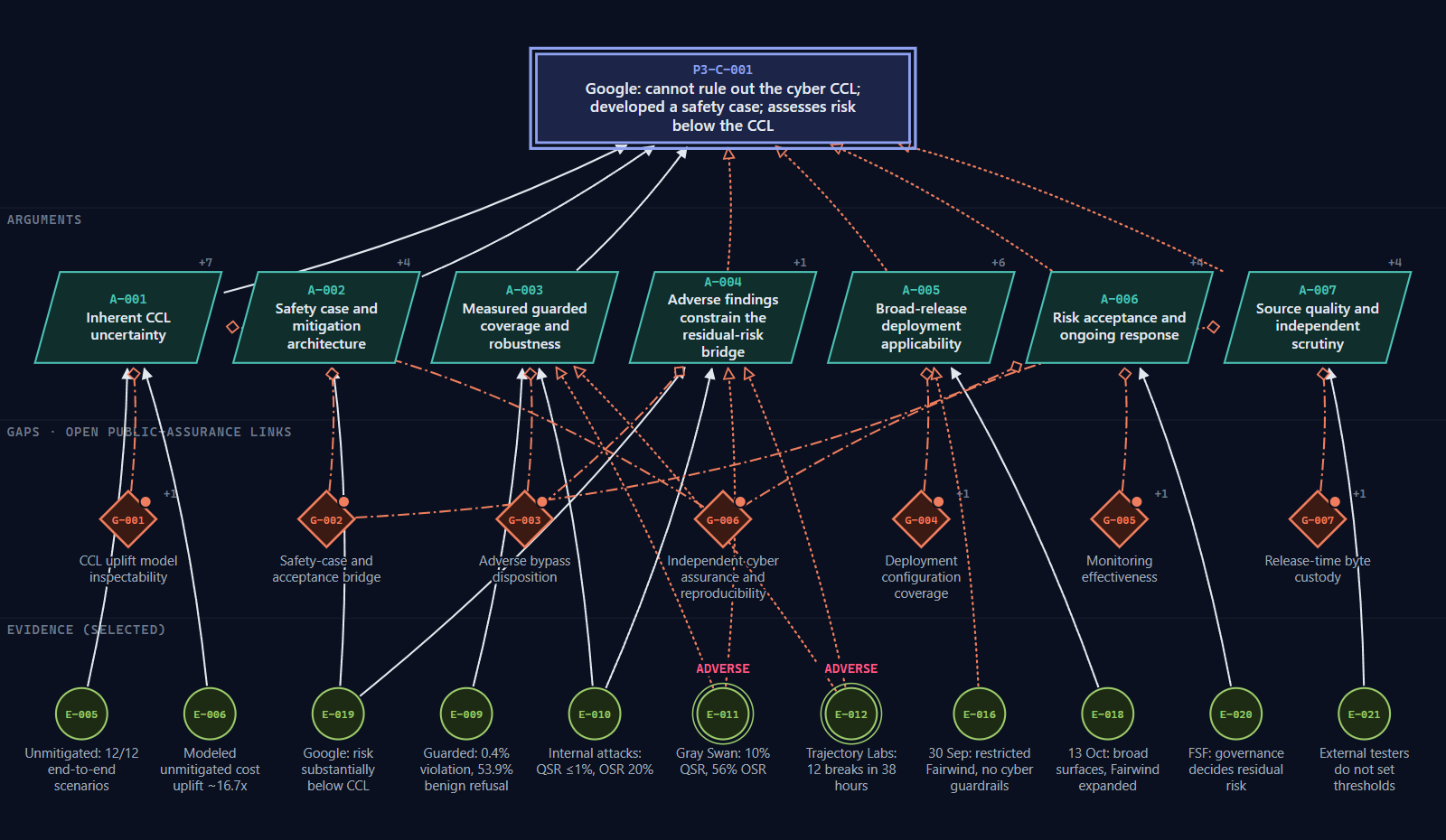
Select any node to inspect its register record, configuration, limitations, provenance and relationships. Drag to pan, scroll or pinch to zoom.
P3 uses five relationship types: supports, qualifies, conditions, assumed_by and limits. Three arguments support the root; four qualify it.
Findings
What the public evidence supports
Google’s report gives concrete numbers. They come from three different settings and measure different things: scenarios, segments, modeled multipliers, per-query rates, per-objective rates, hours and requests. ARGUS never pools them, and none of them is a deployment-wide probability of harm. Each figure below links to its PDF page.
QSR (query success rate) counts individual attack prompts that produce an actionable breach. OSR (objective success rate) counts harmful goals for which the attacker gets at least one breach across all attempts. A low QSR and a high OSR can both be true of the same test.
Unmitigated Model C
The model without out-of-model production safeguards: a capability test, not a test of the deployed system.
12/12
end-to-end CyScenarioBench scenarios solved
A challenge count, not repeated trials. Two solves took unintended routes, which may overstate intended-task performance. Report p.37
77/82
scenario segments solved
Read from Figure 3.2. The benchmark is saturated, so it no longer upper-bounds capability. Report p.37
9x–100x
modeled unmitigated cost uplift across 22 historical attack chains
Geometric mean about 16.7x. A modeled multiplier, not observed harm; Google calls the quantitative scores substantially uncertain. Report p.37
TAC-4
no challenges at this tier
The cost model assumes TAC-4 performance from the measured time horizon and reliability. Report p.34
Guarded endpoints, latest mitigations
Google’s safeguarded evaluations in §3.3, run by Google.
100%
of CyScenarioBench and ExploitBench milestones refused
The milestone denominator is not supplied. Report p.57
0.4%
malicious violation rate, cyber conversational set
About 1,000 examples over 1 to 5 turns; chart value from Figure 3.9. Report p.57
53.9%
benign cyber refusal rate, same set
The utility cost of a deliberately wider safety margin, which Google acknowledges; chart value from Figure 3.9. Report p.57
1% / <1%
query success rate (QSR), static / adaptive attacks
Per-query actionable breach. Figure 3.10, with 95% Jeffreys intervals whose endpoints are not printed. Report p.60
20%
objective success rate (OSR) in both chart groups
At least one breach per harmful seed objective across attempts. Prose separately reports adaptive OSR of 0% single-turn, 40% multi-turn and 20% combined. Report p.60
External red teams, guarded endpointsADVERSE
Tests run by external parties and narrated in Google’s report. The graph marks both as adverse findings.
10% QSR
Gray Swan, 25 high-severity cyber tasks, Shade attacker at high thinking
Google reports 10% per-query success, down from 14% on the cited predecessor. Report p.62
56% OSR
Gray Swan, objective-level success, same test
More than half of seed objectives reached at least one success (chart value, Figure 3.10; 76% on the predecessor). Retry budget and task-level results are not printed. Report p.60
12 breaks
Trajectory Labs: 9 technique families, 38 hours, over 4,000 requests
No new universal jailbreak in that window. One detailed success took about 7 hours, 900 turns and more than 160 sessions, plus substantial human planning. Report p.62
Within one test, against the cited predecessor
Google compares Argon with an earlier Gemini model on the same test and metric. Those pairs are the only comparisons shown here; bars on different rows are different tests and are not comparable with each other. Lower is better for the defender.
What the numbers support, and what they do not
The unmitigated results are substantial risk signals, and they make Google’s decision to mitigate as if the CCL could be reached coherent. They do not confirm a crossing: the report labels its quantitative scores uncertain, has no TAC-4 challenges, and notes that novel attacks could exceed its historical reference class.
The guarded results give meaningful, bounded support for safer responses and higher attacker friction, with a real cost to benign users. The external results show that “near-zero per query” is not “no objective can be reached”. Google says so itself: safeguards impose friction rather than eliminate risk, persistent actors may achieve partial bypasses, and reactive detection has discovery lag (p.63).
Dual-use capability results elsewhere in the report (ExploitBench 87% best-of-three, 86% internal vulnerability discovery, 72% internal exploitation pass@1; pp.213–215) reinforce why safeguards matter. They are not guarded misuse tests.
The missing link
The bridge from results to the below-CCL judgement
Steps 1 to 3 are on the public record, and step 5 is Google’s stated judgement that, with these safeguards, cyber risk sits below the CCL. Step 4 is what connects them. The Frontier Safety Framework calls for it to be an explicit residual-risk and governance determination (FSF p.10). The public record says a case was developed and gives the conclusion; it does not show that reasoning.
STEP 1
Capability
Cannot rule out the CCL; 12/12 unmitigated scenarios; ~16.7x modeled uplift
Public
STEP 2
Safety case
Developed before launch; layered classifiers, probes, monitoring, weight security
Described
STEP 3
Guarded tests
Strong direct-request coverage; low QSR; 56% Gray Swan OSR; 12 Trajectory breaks
Public, mixed
STEP 4
Acceptance
Criteria, residual-uplift calculation, adverse-result dispositions, decision record
Not public · G-002
STEP 5
Below CCL
Google’s residual-risk assessment for the 13 October release
Google’s judgement
What is missing, in the gap register’s words
The internal case and decision may be complete and well supported. The public report is consistent with that; it cannot independently establish it. Read G-002 in the graph.
Release boundary
Two rollouts, two configurations
30 SEPTEMBER · RESTRICTED
Fairwind trusted access
Google announced Argon for trusted defenders and internal teams without cyber guardrails, with broad availability still to come (30 September post). The report describes Fairwind’s tailored mitigations and continuous monitoring that permit specialised dual-use work (pp.12–13).
A distinct phase and configuration. Its access terms are never used as broad-release terms, and its evidence is not pooled with broad-release guardrail tests.
13 OCTOBER · BROAD
The release this case examines
Google began a broader rollout across API and AI Studio, Antigravity, the Gemini app and AI Mode (launch post), with Gemini for business on the model card, p.4, and separately expanded Fairwind (safety post).
The report says inference safeguards may be used as appropriate and that intervention style depends on surface. No public per-surface configuration map exists (G-004).
The 14 October capture and the release-day bytes
17 Apr 2026
Frontier Safety Framework v3.1 published
General process, not Argon-specific fulfilment evidence.
30 Sep 2026
Restricted Fairwind rollout announced
Trusted defenders and internal teams, described as without cyber guardrails; broad release still to come. The retrieved post was modified on 1 October.
13 Oct 2026
Broad rollout begins; Fairwind expanded separately
Launch post 16:00 UTC, safety post 18:00 UTC. API and AI Studio, Antigravity, the Gemini app and AI Mode; the model card adds Gemini for business. Access may vary.
14 Oct 2026
ARGUS captures the six sources
09:44 to 09:50 UTC. These bytes are hashed; the exact 13 October bytes and serving configuration are not authenticated.
The card and report carry only “October 2026” as their date, and the 13 October posts link them. That strongly supports their availability on release day, but the next-day copies cannot by themselves prove the exact release-day wording or the served model and guardrail versions. Model C, the final release candidate, is the tested checkpoint (Table 3.8, pp.161–162). No change is evidenced: this gap (G-007) concerns custody, not a claim that anything was edited.
Open links
Seven open public-assurance gaps
Open each gap for its full investigation, quoted from the gap register: why it matters, what is missing, what would close it, the alternative reading, and the evidence it cites.
G-001CCL uplift model inspectability
Why it matters
Missing public evidence
Evidence that would narrow or close it
Alternative interpretation
Reason missing
Graph links and observed evidence
G-002Safety-case and risk-acceptance bridge
Why it matters
Missing public evidence
Evidence that would narrow or close it
Alternative interpretation
Reason missing
Graph links and observed evidence
G-003Adverse bypass disposition and robustness denominators
Why it matters
Missing public evidence
Evidence that would narrow or close it
Alternative interpretation
Reason missing
Graph links and observed evidence
G-004October broad-release configuration and Fairwind separation
Why it matters
Missing public evidence
Evidence that would narrow or close it
Alternative interpretation
Reason missing
Graph links and observed evidence
G-005Monitoring, enforcement and update effectiveness
Why it matters
Missing public evidence
Evidence that would narrow or close it
Alternative interpretation
Reason missing
Graph links and observed evidence
G-006Independent cyber assurance and reproducibility
Why it matters
Missing public evidence
Evidence that would narrow or close it
Alternative interpretation
Reason missing
Graph links and observed evidence
G-007Exact release-time source and serving custody
Why it matters
Missing public evidence
Evidence that would narrow or close it
Alternative interpretation
Reason missing
Graph links and observed evidence
Grouping and closure discipline
Method
How to read this work
ARGUS is an independent documentary reconstruction of public sources. No live model was queried, no exploit was run and no confidential source was used. It is not a penetration test, a safety certification, a policy-compliance finding or a ranking of models. The typed graph separates Google’s statements from ARGUS interpretation and records every warrant, assumption and adverse result.
The research was filed on 14 October 2026, the day after the release. This presentation was checked against the filed registers by its author. It has not had an independent fidelity audit, and the study has not been externally peer reviewed. Findings may be revised with cited corrections.
Challenges are welcome: a source locator, contrary evidence or a better argument against any edge or evidence record. Criticism that narrows or corrects a link is a useful outcome.
Provenance
Public sources and provenance
Six public publisher documents. ARGUS hashed the copies it retrieved on 14 October; the links below open the publisher’s current copies, and each note says how they compare. PDF page numbers are one-based file pages; the safety report’s printed page numbers are one lower.
- P3-SRC-001Gemini 4 Argon Model Card (opens in a new tab)
Current publisher PDF. Byte-identical to the ARGUS capture of 14 October 2026 when re-checked the same day. The card says it may be updated.
Dates, capture hash and release-time limits
- Publisher date
- Published October 2026, exact day not printed; no numbered revision. Card says it may be updated.
- ARGUS capture
- 2026-10-14T09:44:59Z; 444,990 B;
562cd3c5deddf75dd2aff7a59dcf6dcc273277eae7d82fe957b6a607d84f7763 - Pages and case use
- 14; root p.11, CCL table pp.12–13, distribution p.4
- Release-time qualification
- October 13 safety post currently links the card. No independently authenticated October 13 copy or digest; exact release-time bytes not established.
- P3-SRC-002Gemini 4 Argon Safety & Security Report (opens in a new tab)
Current publisher PDF, a later revision (R2). Google replaced this file at 10:04 GMT on 14 October 2026, about 20 minutes after the ARGUS capture at 09:44 GMT. ARGUS keeps its captured file (SHA-256 1451f641…) as the source of record and has recorded R2 (SHA-256 446c83a9…) separately. Both have 217 pages and identical charts. On the pages this case cites, six passages changed in grammar or layout only, and one figure changed: on p.157, evaluation awareness tied to automated grading reads 35% of flagged unprompted runs in the capture and 37.8% of unprompted runs in R2. This case cites neither value. No ARGUS finding, figure or page reference is affected.
Dates, capture hash and release-time limits
- Publisher date
- Cover: October 2026; no numbered revision or exact publication day printed.
- ARGUS capture
- 2026-10-14T09:44:44Z; 17,311,582 B;
1451f641e6104778b1a0e7429d9f558325da26968427d53d1fd242b0e4257cba - Pages and case use
- 217; full report read; cyber core pp.34–40, 56–63; checkpoints pp.161–162; security p.160; cyber capability/defense pp.213–217
- Release-time qualification
- October 13 safety post currently links this PDF. No authenticated October 13 byte capture. Public report describes a developed safety case; it is not the separately inspectable complete safety-case file.
- P3-SRC-003Frontier Safety Framework v3.1 (opens in a new tab)
Current publisher PDF. Byte-identical to the ARGUS capture of 14 October 2026 when re-checked the same day.
Dates, capture hash and release-time limits
- Publisher date
- Version 3.1, published 17 April 2026.
- ARGUS capture
- 2026-10-14T09:45:06Z; 447,155 B;
ad10d2d240e0d557ecad406dbccedcbb4a70295f8ba8eec46bfe01803cb9c301 - Pages and case use
- 20; §§1.2–1.3 pp.4–8, §§2.1–2.2 pp.9–12, §5 p.17
- Release-time qualification
- Publisher-dated pre-release framework. Exact September 30/October 13 bytes not independently authenticated. Framework sets process; it is not model-specific fulfilment evidence.
- P3-SRC-00413 October safety announcement (opens in a new tab)
Current publisher page. Byte-identical to the ARGUS capture of 14 October 2026 when re-checked the same day.
Dates, capture hash and release-time limits
- Publisher date
- JSON-LD
datePublished2026-10-13T18:00:00Z,dateModified2026-10-13T18:03:03.833342Z in retained HTML; no numbered revision. - ARGUS capture
- 2026-10-14T09:45:13Z; 978,720 B;
8e41264d6080414c1d846ce01b604dec87e550eaf586e1aa23dacbe4d81ee4d5 - Pages and case use
- HTML, pages N/A; paragraphs beginning “Today, we are beginning to roll out Argon broadly” and “Misuse prevention across high-risk domains”
- Release-time qualification
- Publisher-dated release-day post, retrieved next day. Historical HTML byte identity at posting time not authenticated. Summary of report, not independent test evidence.
- P3-SRC-00530 September initial announcement (opens in a new tab)
Current publisher page. Byte-identical to the ARGUS capture of 14 October 2026 when re-checked the same day. The page itself was modified on 1 October 2026.
Dates, capture hash and release-time limits
- Publisher date
- JSON-LD
datePublished2026-09-30T20:00:00Z,dateModified2026-10-01T21:09:53.663080Z; no numbered revision. - ARGUS capture
- 2026-10-14T09:45:23Z; 1,013,487 B;
75294b5d9676a1b969ef867aad1fdebb041d106281337a864f7a8d8b1b7e6507 - Pages and case use
- HTML, pages N/A; “Leading in defensive cybersecurity,” “Strengthening frontier safeguards before broad availability,” “Rolling out soon”
- Release-time qualification
- Distinct restricted Fairwind phase. The post states trusted defenders/internal teams would receive Argon without cyber guardrails and broad release was future. Retrieved version has a 1 October modification; exact 30 September bytes not authenticated. Never use its access terms as broad-release terms.
- P3-SRC-00613 October broad-launch announcement (opens in a new tab)
Current publisher page. Byte-identical to the ARGUS capture of 14 October 2026 when re-checked the same day.
Dates, capture hash and release-time limits
- Publisher date
- JSON-LD
datePublished2026-10-13T16:00:00Z,dateModified2026-10-13T16:33:42.376998Z; no numbered revision. - ARGUS capture
- 2026-10-14T09:50:13Z; 1,032,640 B;
a53dbf194157dad3cb58de791f3dc93ba0934dc3f2394951821869d0890251b9 - Pages and case use
- HTML, pages N/A; opening availability paragraph and “Bringing state-of-the-art cyber capabilities to more trusted defenders”
- Release-time qualification
- Publisher-dated release-day post, retrieved next day. It lists broad surfaces and expansion of Fairwind separately. Exact release-time HTML bytes not authenticated.
Historical custody rule
Research boundary
Published by Automa Dynamics / ARGUS. Independent research; no affiliation, endorsement or certification by Google or Google DeepMind.
Gaps describe the inspected public record. They do not mean Google lacks private evidence, that a control failed, that a policy was breached or that an incident occurred.
Counts are link judgements, not safety scores, and no cross-model ranking is made.
Proof-3 artifacts
- ViewExecutive assurance graph
- ViewFull assurance graph
- ReadThe seven gap investigations
- InspectMachine-readable Graph JSON
- AboutARGUS method and earlier proofs
- Contacthello@automadynamics.com
Graph SHA-256 7daea553666caed2ed498a5795f06252d31ddde03f5b223a053a799653068469