ARGUS Proof-4
Muse Wonder Full
What the public cybersecurity assurance record establishes
INDEPENDENT RECONSTRUCTION · META · CYBERSECURITY · RELEASED 12 OCTOBER 2026
// The finding
Meta’s public record makes its baseline cybersecurity assessment of Muse Wonder Full inspectable, together with three capability results, a material ExploitGym scoring correction that Meta discloses itself, six guarded attack-success results and three separate launch-chart measures. It supports the statement that Meta assessed the unmitigated model as “moderate or lower” for cybersecurity and reviewed a mitigated assessment before deployment. It does not independently establish how those results map to the threat scenarios the category covers, whether the tested Full results transfer to the smaller Wonder or to the served product, the reasoning that accepted the remaining risk, or how well the controls keep working after launch.
ARGUS records seven open public-assurance gaps. They are requests for inspectable evidence, not findings that controls failed or that internal evidence does not exist.
- Organisation
- Meta
- Tested system
- Muse Wonder Full
- Family extension
- Smaller Muse Wonder, by Meta’s inference
- Risk domain
- Cybersecurity only
- Release
- 12 October 2026
- Sources captured
- 14 October 2026
- Claim
- P4-C-001
- Status
- Technical reconstruction complete. Presentation checked against the filed registers. No independent fidelity audit; not externally peer reviewed.
Scope
The claim under examination
ARGUS takes one sentence from Meta’s model card as the single root claim, P4-C-001, exactly as printed:
“Our evaluations put the unmitigated model at ‘moderate or lower’ for both Cybersecurity and Loss of Control before applying our mitigations.”
In plain English: Meta says its evaluations placed Wonder Full in the ‘moderate or lower’ cybersecurity risk category before applying the additional mitigations described in its assessment. “Moderate or lower” is a category in Meta’s Superintelligence Scaling Framework. It means the model cannot substantially contribute to the catastrophic cyber scenarios the framework defines, while still allowing that it has relevant cyber skills. It is not a promise that every harmful request is refused, and it is not a numerical safety score (framework pp.17–19).
The sentence carries three scope decisions, and ARGUS keeps them apart. The same paragraph also says Meta does not rule out the high-risk threshold in the Chemical & Biological domain, and applies safety post-training and system-level classifiers designed for that domain. That uncertainty and those safeguards are not transferred to cybersecurity.
SCOPE 1
Cybersecurity only
META SAYSThe sentence covers both Cybersecurity and Loss of Control.
ARGUS READSOnly the cybersecurity component is reconstructed. Loss of Control stays in the quotation so Meta’s words are not edited, and is outside this analysis.
SCOPE 2
The unmitigated baseline
META SAYSThe category applies before mitigations. The next sentence reports the same category across all domains with safeguards in place, which supports the decision to deploy.
ARGUS READSThe root is the unmitigated cyber assessment. The mitigated all-domain judgement is context, not a second root, and this case never says cyber risk was reduced from high to moderate.
SCOPE 3
Wonder Full, then the family
META SAYSResults are from Muse Wonder Full, the most capable variant, “which is why the assessment covers every model in the family.”
ARGUS READSWonder Full is the tested variant. Extending its results to the smaller Muse Wonder is Meta’s inference, not independently established equivalence.
The Executive assurance graph gives a readable route from the claim to each gap, with a branch reader built from the executive checklist. The Full graph renders all 54 nodes and 67 warranted relationships, with every evidence record’s setup, limits, page-linked sources and provenance.
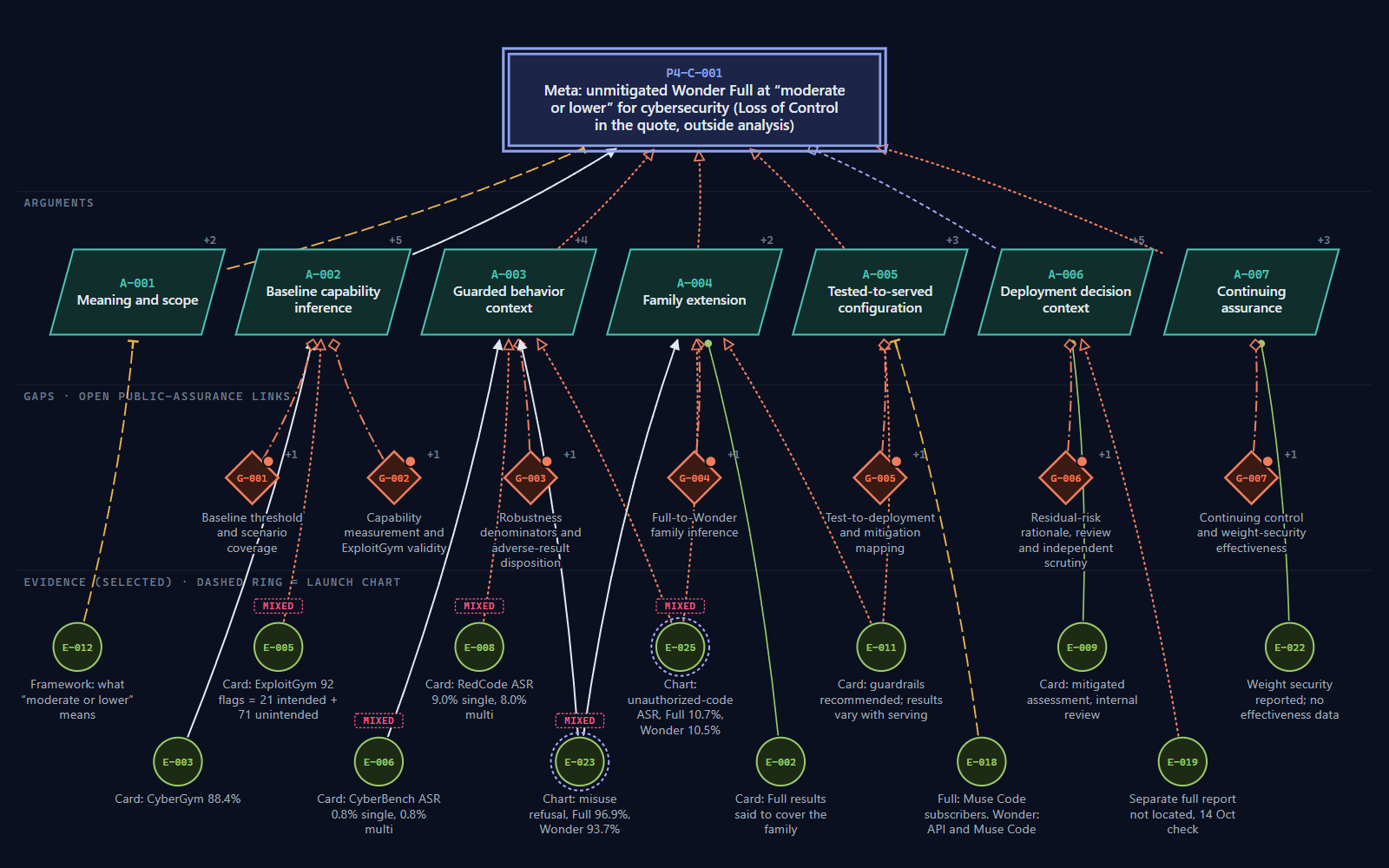
Select any node to inspect its register record, setup, limits, provenance and relationships. Drag to pan, scroll or pinch to zoom.
P4 uses eight relationship types: reports, supports, qualifies, defines scope, contextualizes, conditions, assumed by and limits. At the root, one argument supports, four qualify, one defines scope and one contextualizes.
Baseline
What the cyber risk classification covers
The framework’s cybersecurity category is about catastrophic outcomes, not everyday misuse. It names three outcome families (framework pp.20–22), all ending in large-scale casualties or significant financial loss:
CYBER 1
Lowered barriers or cost for attacks that produce large-scale casualties or significant financial loss.
CYBER 2
Discovery and reliable exploitation of critical zero-day vulnerabilities in popular software.
CYBER 3
Scaled, long-form fraud, extortion and scams.
The framework sets no universal benchmark percentage. Its operational method (pp.30–32) starts with professional offensive tasks compared with human experts, escalates from simple to complex realistic challenges when results warrant it, and looks for reliable, consistent success before a high-risk call. Cyber 3 uses bottleneck analysis and deployment-specific evaluations.
The card publishes three capability results, and they are relevant inputs. What is not public is the Full-specific audit trail connecting them to all three outcome families: human or cost baselines, the escalation decision, complex-challenge results, any Cyber 3 evaluation, and the criterion-by-criterion judgement. A defensible qualitative rule would be enough; nobody needs a magic number. This is G-001. It does not show those evaluations were not done.
Capability
Capability testing, with its qualifications
The card’s capability table reports Wonder Full on three offensive-security benchmarks. These measure what the model can do, not how well safeguards hold. None of the three comes with a task count, number of attempts, repeats, confidence interval, harness description or a record of which mitigations were removed for the run.
Model card · Wonder Full · capability table
Placed under the unmitigated assessment. Developer-reported; ARGUS has not reproduced any result.
88.4%
CyberGym
No cyber-specific task count, pass@k, repeats or interval. Not a safeguard test. Card p.7
58.9%
ExploitBench
Denominator and aggregation not stated. Another developer’s ExploitBench setup is not assumed. Card p.7
21 of 92
ExploitGym: 92 flags captured, only 21 through the intended vulnerability
2171 unintendedintended route: comparable to the published rankingunintended routes: not intended-task successesMeta’s own footnote: a verification pass with a GPT-cyber verifier, “independently confirmed with Gemini 3.1 Pro”, found 21 flags used the intended vulnerability and 71 came through unintended ones, so 21 “is the figure comparable to the published ranking.” These are counts of flags, not a percentage or task denominator. Card p.7
Reading the ExploitGym correction both ways
Disclosing the split is useful: it stops the 92-flag headline being read as a count of intended exploits, and ARGUS never presents it as one. But the 71 unintended routes are not nothing either. They raise a benchmark-validity question, and they may still show real exploitation capability. They do not, by themselves, show a production compromise, a safeguard bypass or a catastrophic outcome.
Two model verifiers agreeing is developer-reported cross-checking, not an independent institutional audit; shared adjudication errors remain possible. The public record has no attempted-task total, no verifier confusion matrix and no sanitized flag-by-flag adjudication. This is G-002.
Guarded behaviour
Guarded results, including the attacks that succeeded
Attack success rate (ASR) is the share of attack attempts that succeeded under each test’s own scoring. Lower is better for the defender. An ASR is not a refusal rate: an attack can fail without an explicit refusal. So ARGUS does not subtract these figures from 100, does not average them, and does not turn any row into a real-world probability of harm.
The card’s adversarial-refusal table reports six ASRs for Wonder Full, single-turn and multi-turn, on three separate setups (card pp.7–8). Each setup keeps its own name: CyberBench is not treated as Cybench.
Model card · Wonder Full · adversarial refusal table
Attack success rate, %, lower is better. No denominators, attempts, budgets, scoring rules or safeguard stack are published.
| Setup | Single turn | Multi turn |
|---|---|---|
| CyberBenchE-006 | 0.8% | 0.8% |
| PolyGuard, cyber subsetE-007 | 1.1% | 2.3% |
| RedCodeE-008 | 9.0% | 8.0% |
These are favourable results within their test conditions, and ARGUS reports them as such. They are also not zero. RedCode’s 9.0% and 8.0% are a material qualification to Meta’s summary that Wonder Full “demonstrates strong robustness to adversarial attacks across all benchmarks”. PolyGuard’s multi-turn value is higher than its single-turn one and RedCode’s is lower; without task and budget detail, neither shows that extra turns help or hurt in general.
SEPARATE SOURCE · LAUNCH RESEARCH POST
Launch charts · Full and smaller Wonder at max reasoning effort
Three charts linked from Meta’s launch post, separate from the model card. Each is its own setup with its own metric. They are not complements or averages of the six card ASRs, and none publishes a sample size, attack portfolio, scoring rule or control stack. Other models’ bars are left in the original charts; no ranking is made.
Cyber Misuse Refusal Benchmark
refusal rate, higher is better · original chart (opens the publisher’s image in a new tab)
E-023
Wonder Full (max)96.9%Muse Wonder (max)93.7%Cyber Defense Compliance Benchmark
compliance rate, higher is better · original chart (opens the publisher’s image in a new tab)
E-024
Wonder Full (max)93.3%Muse Wonder (max)94.5%Executing Unauthorized Code
attack success rate, lower is better · original chart (opens the publisher’s image in a new tab)
E-025
Wonder Full (max)10.7%Muse Wonder (max)10.5%
The misuse-refusal result is a measured refusal rate in its own setup, and it is favourable. Defensive compliance is useful evidence that legitimate security work is not simply blocked, though compliance alone does not prove a successful defence. The unauthorized-code result is an adverse, adjacent system-security observation: about one attack in ten succeeded in that setup, for both models. The source does not say how those attacks were built, so ARGUS does not call it prompt injection or a production incident.
Neither the card table nor the charts give the denominators, budgets, rubrics, uncertainty, severity classes or retest accounting needed to read the remaining successes as deployment risk. Nonzero ASR alone neither establishes catastrophic risk nor contradicts a moderate-or-lower call; an explicit risk argument has to explain why the successes matter or do not. This is G-003.
Family inference
Wonder Full and the smaller Wonder
Muse Wonder Full is a separate named model, not a reasoning setting of the smaller Muse Wonder. The launch posts announce them through different routes (launch research, announcement).
TESTED VARIANT
Muse Wonder Full
Announced for Muse Code subscribers. Every §4 cyber result in the model card is for this model.
API availability for Full is not established by the launch sources.
COVERED BY INFERENCE
Muse Wonder
Announced on the Meta Model API and Muse Code. Covered by Meta’s statement that Full’s results are “why the assessment covers every model in the family”.
Wonder-powered Muse experiences are described as forthcoming, first for subscribers.
Testing the most capable variant can be a sensible way to bound some offensive capabilities. It does not automatically bound every specialised capability or refusal behaviour, and the launch charts show why. On the same chart and setup, Full refuses more misuse (96.9% against 93.7%), complies slightly less often with defensive requests (93.3% against 94.5%) and has a fractionally higher unauthorized-code ASR (10.7% against 10.5%). With no uncertainty or methods published, ARGUS draws no significance or general ordering from those small differences.
The paired charts narrow the family gap; they do not close it. There are no paired catastrophic-capability evaluations, no matched-test manifest and no domain-specific argument that Full bounds the smaller Wonder across assessment and deployment. This is G-004. It limits the family extension, not the identity of the Full root.
Deployment
The tested system and the served system
Recommended is not active
The card recommends deploying Wonder “as part of a broader AI system, with additional guardrails suited to the use case”, and human-in-the-loop confirmation for irreversible actions in agentic use.
ARGUS READSRecommendations to deployers do not show which controls are switched on in Muse Code or on the API.
Results depend on configuration
The card says performance can vary with quantization, serving configuration, prompts, tools and the agent harness, and that testing has not covered all scenarios.
ARGUS READSNo dated matrix maps the tested checkpoint, tools and safeguards to each served route.
Policy options are not an inventory
The framework lists classifiers, rate limits, abuse monitoring, identity controls and logging as examples for cyber.
ARGUS READSThese are conditional policy options, not a documented cyber stack for Full. The chemical and biological classifiers do not fill this in.
Common infrastructure could make the tests representative of what users reach; the public documents do not establish it. ARGUS does not infer that the recommended guardrails were active, and does not carry chemical and biological safeguard details into cyber. The time boundary matters too: the sources were captured on 14 October, so the exact 12 October text and serving configuration remain unauthenticated. This is G-005.
The missing link
The reasoning that accepted the remaining risk
Steps 1 to 3 are on the public record, and step 5 is Meta’s stated deployment judgement. Step 4 is what connects them. The framework expects preparedness reporting to explain the risk rationale, mitigation adequacy, adverse behaviours and governance (framework pp.9–11). The card says the review happened and gives the conclusion; it does not show that reasoning.
STEP 1
Baseline
Unmitigated cyber risk: “moderate or lower”
Meta’s assessment
STEP 2
Capability
CyberGym 88.4%; ExploitBench 58.9%; ExploitGym 21 intended of 92 flags
Public, qualified
STEP 3
Guarded tests
Six card ASRs from 0.8% to 9.0%; three separate launch charts
Public, mixed
STEP 4
Acceptance
Criteria, treatment of remaining successes, dated accountable review, independent assessment
Not public · G-006
STEP 5
Deployment
With safeguards: “moderate or lower” across all domains; internal governance review before the decision
Meta’s statement
What is missing, in the gap register’s words
Meta also reports working with third parties to develop and license benchmarks, threat modelling with outside experts, and engagement with government and other stakeholders (card p.11). Those are real inputs, but benchmark provenance, external execution and independent endorsement of the risk judgement are different things, and none stands in for another.
The internal record may be complete and well supported. The public record is consistent with that; it cannot independently establish it. No breach of a publication deadline is inferred. Read G-006 in the graph.
Open links
Seven open public-assurance gaps
UNKNOWN_REASON is preserved unless a source gives a specific reason.Open each gap for its full investigation, quoted from the gap register: what is public, what is missing, the evidence that would narrow or close it, the alternative reading, and why the evidence is unavailable where a source says.
G-001Baseline threshold and scenario coverage
Observed public evidence
Missing inference or evidence
Evidence that would narrow or close it
Alternative interpretation
Reason unavailable
Graph links and cited evidence
In the graph, G-001 limits A-002 and D-001. The gap register cites:
G-002Capability measurement and ExploitGym validity
Observed public evidence
Missing inference or evidence
Evidence that would narrow or close it
Alternative interpretation
Reason unavailable
Graph links and cited evidence
In the graph, G-002 limits A-002 and D-002. The gap register cites:
G-003Robustness denominators and adverse-result disposition
Observed public evidence
Missing inference or evidence
Evidence that would narrow or close it
Alternative interpretation
Reason unavailable
Graph links and cited evidence
In the graph, G-003 limits A-003 and D-003. The gap register cites:
G-004Full-to-Wonder family inference
Observed public evidence
Missing inference or evidence
Evidence that would narrow or close it
Alternative interpretation
Reason unavailable
Graph links and cited evidence
In the graph, G-004 limits A-004 and D-004. The gap register cites:
G-005Test-to-deployment and mitigation mapping
Observed public evidence
Missing inference or evidence
Evidence that would narrow or close it
Alternative interpretation
Reason unavailable
Graph links and cited evidence
In the graph, G-005 limits A-005 and D-005. The gap register cites:
G-006Residual-risk rationale, review and independent scrutiny
Observed public evidence
Missing inference or evidence
Evidence that would narrow or close it
Alternative interpretation
Reason unavailable
Graph links and cited evidence
In the graph, G-006 limits A-006 and D-006. The gap register cites:
G-007Continuing control and weight-security effectiveness
Observed public evidence
Missing inference or evidence
Evidence that would narrow or close it
Alternative interpretation
Reason unavailable
Graph links and cited evidence
In the graph, G-007 limits A-007 and D-007. The gap register cites:
Grouping choices and limits
Provenance
The full report, the sources and their dates
Separate full safety report
NOT_LOCATED_IN_BOUNDED_PUBLIC_SEARCH · 14 October 2026, 13:11 UTC
Both launch publications say “A full report with additional safety evaluations will be available soon” (launch research, announcement). The launch page’s existing evaluation-report link points to the model card. The publisher’s research index, launch links, framework links and targeted searches did not locate a separate report.
This is a dated public-evidence limitation. It does not show that no report exists, that Meta lacks internal evidence, or that anything was deliberately withheld. A report found later would need its own assessment, and would narrow the gaps only as far as it supplies the missing evidence.
Release, capture and the release-day bytes
2 Oct 2026
Scaling Framework v2.1 dated and explained
Framework p.51 and the explanation post agree on the date. General policy, not Wonder-specific fulfilment evidence.
12 Oct 2026
Muse Wonder and Muse Wonder Full released
Model card, launch research post and announcement (17:08 UTC). Both launch publications say a fuller safety report “will be available soon”.
13 Oct 2026
Its page metadata records a modification at 17:27 UTC. The exact 12 October wording is not presumed.
14 Oct 2026
ARGUS captures the sources and checks for the report
Six documents captured 13:08 to 13:10 UTC; report-availability check 13:11 UTC; three launch charts captured 13:19 UTC. Hashes identify these bytes, not the release-day bytes or serving configuration.
Nine public publisher files: six documents and three chart images from the launch post, which are components of one publication, not three independent studies. ARGUS hashed the copies it retrieved on 14 October; the links below open the publisher’s current copies, and each note says how they compare. PDF page numbers are one-based file pages.
- P4-SRC-001Muse Wonder Model Card (opens in a new tab)
Current publisher PDF. Byte-identical to the ARGUS capture of 14 October 2026 when re-checked the same day.
Dates, capture hash and release-time limits
- Publisher date
- Release date: 2026-10-12 (card p.1); document publication day not separately stated.
- Revision
- No numbered revision; PDF metadata has title/producer, no creation or modification date.
- ARGUS capture (UTC)
- 2026-10-14T13:08:50.776999+00:00; request began 2026-10-14T13:08:50.483363+00:00.
- Pages and case use
- Root §4 p.7; cyber capability p.7; robustness p.8; governance/limitations pp.11–12. Model card has no cyber-method appendix.
- Release-time limit
- Current publisher copy only; exact 12 October bytes not independently authenticated. The PDF title/producer metadata contain no publication timestamp.
- SHA-256 of the capture
63e19276146bc146f1a14a2534360b9712641918f617ca432ef1443991f4edce
- P4-SRC-002Meta Superintelligence Scaling Framework v2.1 (opens in a new tab)
Current publisher PDF. Byte-identical to the ARGUS capture of 14 October 2026 when re-checked the same day.
Dates, capture hash and release-time limits
- Publisher date
- 2026-10-02, Appendix II p.51; header October 2026.
- Revision
- Version 2.1; preface p.3 and changelog pp.50–51.
- ARGUS capture (UTC)
- 2026-10-14T13:08:50.832277+00:00; request began 2026-10-14T13:08:50.484287+00:00.
- Pages and case use
- Thresholds pp.17–19; cyber outcomes pp.20–22; cyber operationalization pp.30–33; governance/disclosure pp.5–13; evaluation validity pp.28–30.
- Release-time limit
- Current publisher copy only; exact 12 October bytes not independently authenticated. The PDF title/producer metadata contain no publication timestamp.
- SHA-256 of the capture
5a01d327df6dd81f2be886ea6006dbb53a64c37b359c7bd95346dd718819c64f
- P4-SRC-003Muse Wonder launch research (opens in a new tab)
Current publisher page. Re-checked the same day: the visible text is identical to the ARGUS capture; the bytes differ only in per-request page-tracing tokens.
Dates, capture hash and release-time limits
- Publisher date
- 2026-10-12T00:00:00.000Z.
- Revision
- HTML dateModified: 2026-10-12T00:00:00.000Z.
- ARGUS capture (UTC)
- 2026-10-14T13:08:51.381261+00:00; request began 2026-10-14T13:08:50.485094+00:00.
- Pages and case use
- Distinct model access routes; safety/report promise; publisher links to card and framework.
- Release-time limit
- Current publisher copy only; exact 12 October bytes not independently authenticated. HTML dates are publisher metadata, not independent timestamp attestations.
- SHA-256 of the capture
df7fc46cfdf0c66afbd38b9ef099ca31125ed2135bb3c6a085986a184b92f5a0
- P4-SRC-004Introducing Muse Wonder and Muse Wonder Full (opens in a new tab)
Current publisher page. Byte-identical to the ARGUS capture of 14 October 2026 when re-checked the same day. The page records a 13 October modification.
Dates, capture hash and release-time limits
- Publisher date
- 2026-10-12T17:08:05+00:00.
- Revision
- HTML dateModified: 2026-10-13T17:27:26+00:00.
- ARGUS capture (UTC)
- 2026-10-14T13:08:55.020961+00:00; request began 2026-10-14T13:08:50.485943+00:00.
- Pages and case use
- Corroborating announcement and route/report promise; updated after release.
- Release-time limit
- Current publisher copy only; exact 12 October bytes not independently authenticated. HTML dates are publisher metadata, not independent timestamp attestations.
- SHA-256 of the capture
8d82a0cb17d15cb54b9750892d5be7039feede9df7bdcdc890db2b9492a4090a
- P4-SRC-005Developing Capable Models Responsibly (opens in a new tab)
Current publisher page. Re-checked the same day: the visible text is identical to the ARGUS capture; the bytes differ only in per-request page-tracing tokens.
Dates, capture hash and release-time limits
- Publisher date
- 2026-10-02T00:00:00.000Z.
- Revision
- HTML dateModified: 2026-10-02T00:00:00.000Z.
- ARGUS capture (UTC)
- 2026-10-14T13:08:50.978007+00:00; request began 2026-10-14T13:08:50.486669+00:00.
- Pages and case use
- Dates framework update and explains containment/open-weight changes; future governance language is not completed review evidence.
- Release-time limit
- Current publisher copy only; exact 12 October bytes not independently authenticated. HTML dates are publisher metadata, not independent timestamp attestations.
- SHA-256 of the capture
0b15ca42449e12330802845e7c160157c12d59e7307122d5f1156f0c79798664
- P4-SRC-006Meta AI Research index (opens in a new tab)
Dynamic publisher index. Re-checked the same day: the visible text is identical to the ARGUS capture; the bytes differ only in per-request page-tracing tokens. An index cannot prove that a report is absent elsewhere.
Dates, capture hash and release-time limits
- Publisher date
- Dynamic index; no single publication date.
- Revision
- No numbered revision; featured Wonder post dated 2026-10-12.
- ARGUS capture (UTC)
- 2026-10-14T13:10:33.286878+00:00; request began 2026-10-14T13:10:32.832621+00:00.
- Pages and case use
- Availability-check context only; dynamic index cannot prove absence elsewhere.
- Release-time limit
- Current publisher copy only; exact 12 October bytes not independently authenticated. HTML dates are publisher metadata, not independent timestamp attestations.
- SHA-256 of the capture
7f862c84ed09ee1e4de77c81c46f2fa09b406e1de8769099437bfc69ec740c87
- P4-SRC-007LAUNCH CHARTCyber Misuse Refusal Benchmark (opens in a new tab)
Byte-identical to the ARGUS capture of 14 October 2026 when re-checked the same day. A component of the launch research post, not an independent study. ARGUS transcribes only the two Muse Wonder bars; the other bars are left in the original and no ranking is made.
Dates, capture hash and release-time limits
- Publisher date
- Linked from launch post dated 2026-10-12; standalone asset publication date unknown.
- Revision
- Filename light-v2; HTTP Last-Modified Wed, 14 Oct 2026 10:20:06 GMT (not a semantic change log); ETag
"effddce0f8a8a1db9eca0f40f9aa72ac". - ARGUS capture (UTC)
- 2026-10-14T13:19:24.363049+00:00
- Parent publication
- Meta; P4-SRC-003, Safety at the Frontier, serialized chart reference.
- Release-time limit
- Read chart labels and axes directly. No chart-specific sample sizes, repeats, uncertainty or method manifest; no authenticated launch-day chart bytes. This is a component of the launch publication, not an independent study.
- SHA-256 of the capture
d5a2dce55e87673bfc6ab15e969a26fc747fe2c202233c9456f68634729ee412
- P4-SRC-008LAUNCH CHARTCyber Defense Compliance Benchmark (opens in a new tab)
Byte-identical to the ARGUS capture of 14 October 2026 when re-checked the same day. A component of the launch research post, not an independent study. ARGUS transcribes only the two Muse Wonder bars; the other bars are left in the original and no ranking is made.
Dates, capture hash and release-time limits
- Publisher date
- Linked from launch post dated 2026-10-12; standalone asset publication date unknown.
- Revision
- Filename light-v3; HTTP Last-Modified Wed, 14 Oct 2026 10:20:07 GMT (not a semantic change log); ETag
"5f3d121b35ddce7ea582485e1c61f439". - ARGUS capture (UTC)
- 2026-10-14T13:19:24.369365+00:00
- Parent publication
- Meta; P4-SRC-003, Safety at the Frontier, serialized chart reference.
- Release-time limit
- Read chart labels and axes directly. No chart-specific sample sizes, repeats, uncertainty or method manifest; no authenticated launch-day chart bytes. This is a component of the launch publication, not an independent study.
- SHA-256 of the capture
d044921db534a68665e6ad116dca79ab4529359327da98b1e8623ea274b9a16e
- P4-SRC-009LAUNCH CHARTExecuting Unauthorized Code (opens in a new tab)
Byte-identical to the ARGUS capture of 14 October 2026 when re-checked the same day. A component of the launch research post, not an independent study. ARGUS transcribes only the two Muse Wonder bars; the other bars are left in the original and no ranking is made.
Dates, capture hash and release-time limits
- Publisher date
- Linked from launch post dated 2026-10-12; standalone asset publication date unknown.
- Revision
- Filename light-v2; HTTP Last-Modified Wed, 14 Oct 2026 10:20:01 GMT (not a semantic change log); ETag
"da5eee445f7d1e1748928adcde320264". - ARGUS capture (UTC)
- 2026-10-14T13:19:24.377084+00:00
- Parent publication
- Meta; P4-SRC-003, Safety at the Frontier, serialized chart reference.
- Release-time limit
- Read chart labels and axes directly. No chart-specific sample sizes, repeats, uncertainty or method manifest; no authenticated launch-day chart bytes. This is a component of the launch publication, not an independent study.
- SHA-256 of the capture
8ad34f90d072bce338031ca62783f835191aa731ef4ff0b536e7f7b87c8c55cd
What the hashes do and do not prove
Publisher-domain acquisition and the publisher’s own cross-links establish where these copies came from. The hashes identify the retained bytes; they are not publisher signatures and do not authenticate the results. Exact 12 October bytes and serving configurations were not independently authenticated, and the charts’ 14 October Last-Modified dates do not show when their content first appeared. No change to the card is alleged, and current evidence is not backdated.
Method
How to read this work
ARGUS is an independent documentary reconstruction of public sources. No model was queried, no exploit was run and no confidential source was used. It is not a penetration test, a safety certification, a policy-compliance finding or a ranking of models. The typed graph separates Meta’s statements from ARGUS interpretation and records every warrant, assumption and adverse result.
The research was filed on 14 October 2026, two days after the release. This presentation was checked against the filed registers by its author. It has not had an independent fidelity audit, and the study has not been externally peer reviewed. Findings may be revised with cited corrections.
Challenges are welcome: a source locator, contrary evidence or a better argument against any edge or evidence record. Criticism that narrows or corrects a link is a useful outcome.
Research boundary
Published by Automa Dynamics / ARGUS. Independent research; no affiliation, endorsement or certification by Meta.
Gaps describe the inspected public record. They do not mean Meta lacks private evidence, that a control failed, that a policy was breached or that an incident occurred.
Counts are link judgements, not safety scores, and no cross-model ranking is made.
Proof-4 artifacts
- ViewExecutive assurance graph
- ViewFull assurance graph
- ReadThe seven gap investigations
- InspectMachine-readable Graph JSON
- AboutARGUS method and earlier proofs
- Contacthello@automadynamics.com
54 nodes · 67 warranted relationships · 25 evidence units · 7 open gaps · Graph SHA-256 47e5d31e3ace171cea058b103ebef1f589258bcce9cef6ab37e427392ce823ba