002 / OPERATIONAL TRUTH
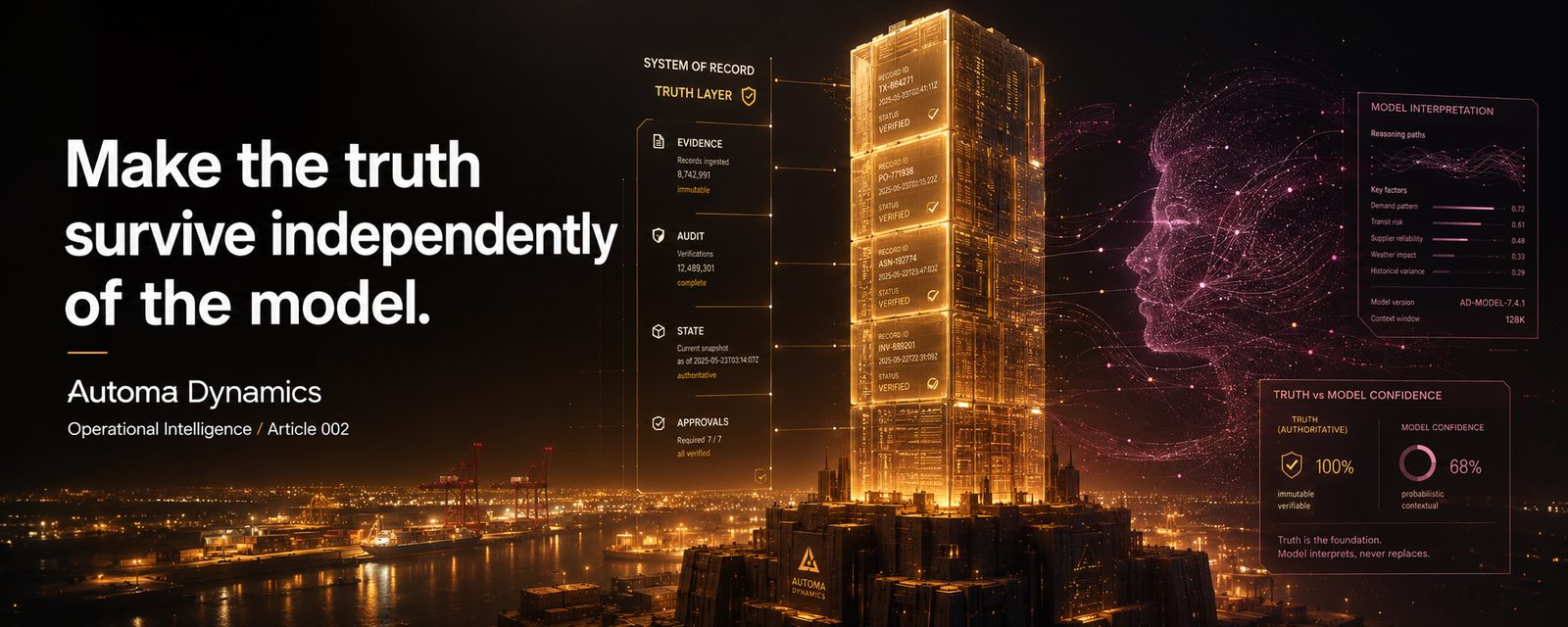
Give an AI access to enough company data and something remarkable happens: it can answer questions that once required someone to know which system to open, which report to run, which spreadsheet to find, and which person to ask.
- "Which customers are waiting for this product?"
- "What contracts expire next month?"
- "Why did logistics costs increase?"
- "Which suppliers are associated with these components?"
- "Summarise everything we know about this account."
The interface becomes conversational, and the boundaries between systems begin to disappear. This creates a subtle architectural temptation: if the AI can see everything, reason across everything, and explain everything, perhaps the AI itself can become the place where the organisation's truth lives.
That would be a serious mistake. An enterprise AI can become an extraordinarily powerful interpreter of operational reality, but the reality itself needs firmer foundations.
Companies Already Struggle with Competing Versions of Reality
Ask a simple question inside a large organisation: How many units do we have available? The answer depends on who, and what you ask:
- A warehouse system reports physical stock.
- An ERP reports booked inventory.
- Planning software subtracts allocations.
- A sales system includes stock already promised to customers.
- A spreadsheet contains a manual adjustment made yesterday.
- Someone on the warehouse floor knows a pallet was damaged this morning and hasn't been recorded yet.
Every number can be legitimate within its own context, but none automatically represents the true operational answer. This is why companies spend enormous effort establishing systems of record, reconciliation processes, master data, controls, and ownership. AI arrives on top of that environment; it does not remove the underlying problem, it makes resolving it more urgent. An AI capable of combining five conflicting answers into one confident sentence can make confusion look remarkably authoritative.
Fluency Changes How Uncertainty Feels
Traditional software usually exposes its limitations: a database returns an empty field, a query fails, or two reports visibly disagree. The friction is obvious.
Generative AI smooths that friction away. When information is incomplete, a language model can still produce a coherent explanation. When terminology is ambiguous, it infers meaning. When evidence points in different directions, it constructs a plausible narrative.
These abilities are useful, but they change the psychology of the interface. Humans naturally associate clarity with understanding - a well-formed answer feels resolved. Operational reality, however, frequently remains unresolved with stale data, contradictory records, delayed events, and missing evidence.
The system must preserve critical boundaries:
- What the organisation knows vs. what a particular system reports
- What has been inferred vs. what remains uncertain
- What has been superseded over time
- What a user has permission to see vs. authority to change
The language model should help communicate these distinctions, not silently erase them.
"The AI Said So" Cannot Become an Evidence Model
Imagine an executive asks why a customer order will arrive late. The AI answers: "A component shortage at the primary factory has delayed production by six days."
That sentence may be correct, but an operational system must survive the follow-up: How do you know?
In a robust architecture, the answer leads somewhere concrete:
- A shipment was delayed containing a specific batch.
- That batch contains a required component.
- Available inventory cannot cover planned demand, impacting the production order.
- The customer order depends on that production order, pushing the date past the commitment.
Every step can be inspected, every object has an identity, every state has a timestamp, and every conclusion has evidence. Compare that to: "The AI reviewed our supply chain information and determined a six-day delay."
In the second scenario, we have lost everything that matters. Trustworthy enterprise intelligence requires the ability to trace backwards from conclusion to evidence. The explanation is useful; the evidence chain is fundamental.
Retrieval Alone Does Not Solve Authority
A common enterprise AI pattern indexes documents, exposes databases through tools, and retrieves context for the model. While valuable, this leaves the core problem of authority unaddressed:
- A search retrieves three contracts: Which version is active?
- A tool returns an inventory record: What exact moment does it represent?
- A CRM note describes a customer commitment: Does that create a contractual obligation?
- Two systems contain slightly different supplier names: Are they the same legal entity?
- A document contains process instructions: Did the author have authority to change the process?
Retrieval gives the model evidence, but something still has to define what that evidence actually means.
Operational Truth Needs Structure
For AI to reason reliably, a company needs a coherent model of its operational world: suppliers, customers, contracts, components, shipments, factories, employees, orders, assets, events, and decisions.
The identities and relationships between these objects must have defined meaning:
- A shipment connects to what it contains.
- A component connects to the products that require it.
- An order connects to a customer commitment.
- An approval connects to the individual and their delegated authority.
Time matters just as much. "There are 4,000 units in Manchester" is an incomplete statement. Were there 4,000 at 09:00, or are there 4,000 now? Were 1,500 subsequently reserved? Did 500 leave? The system needs enough structure to answer those questions before an AI turns the result into prose.
Permission to Be Uncertain
One of the healthiest behaviours an enterprise AI can develop is refusing to manufacture certainty.
Suppose two systems disagree on a delivery date. The useful response is:
"The delivery date cannot be established confidently. The transport record reports Tuesday while the receiving system reports Thursday. The discrepancy requires reconciliation."
That answer is less flashy than inventing a single date, but it is far more valuable. In business, ambiguity carries real consequences for cash flow, safety, and contracts. Sometimes the correct machine action is analysis; sometimes it is escalation, asking a human, or waiting until better evidence arrives.
Action Raises the Stakes
The source of truth problem intensifies when AI moves from answering questions to taking autonomous actions.
Consider an AI agent tasked with protecting customer deliveries. It detects a late shipment, identifies an alternative supplier, and calculates that expedited procurement will recover the schedule. Technically, execution is easy. Operationally, critical questions remain:
- Is the alternative supplier approved and the component certified?
- What quantity is genuinely required, and has another order already been placed?
- What financial threshold applies, and who must authorise the cost?
- Does this trigger a contractual change?
A model operating on an approximate version of reality will make perfectly rational decisions about the wrong world. Greater agency demands stronger foundations.
Intelligence and Authority Must Remain Separate
An AI may understand a situation better than the person looking at it, but that does not give it the authority to act.
Companies deliberately separate knowledge from permission. An analyst can identify a problem without having the power to approve the fix. Managers have spending caps; directors have higher limits; certain decisions require dual sign-off or regulatory checks.
This establishes a core principle for enterprise autonomy: capability should expand only inside explicit authority.
An AI can identify, reason, compare, and recommend. Where permitted, it can execute. But the authority to move between those stages must stem from governed organizational rules, never from the model's self-assessed confidence.
The Architecture of Invisible AI
Rather than a single, monolithic intelligence sitting at the centre of the enterprise, the most effective future architecture is distributed:
- Operational systems hold authoritative state.
- A shared organizational model connects core objects, relationships, and constraints.
- Deterministic systems calculate where absolute exactness matters.
- AI operates as an adaptive reasoning and communication layer across that structure.
- Humans remain visible wherever accountability and authority matter.
This setup remains extraordinarily capable. You can query the organisation in natural language across disparate systems, explore complex scenarios, trace evidence chains, and deploy authorised agents to coordinate work. The intelligence becomes more powerful precisely because it no longer has to invent the world beneath it.
The Shift from Model to Architecture
The industry has spent years obsessing over model specs: parameter counts, context windows, and tool integrations. Inside the enterprise, the decisive questions look different:
- What does the AI believe, where did the data originate, and how fresh is it?
- Which underlying system holds ultimate authority?
- What remains uncertain, and what is the user permitted to see?
- Who approved the action, and can the decision path be audited later?
A capable AI can reason over almost anything we feed it. The real engineering challenge is building an operational world worth reasoning over. Give the model access to truth, provide the tools to evaluate that truth, and ensure the truth survives independently of the model.